
Greek Wedding Traditions
and What They Mean
From the crowns joined by a single ribbon to the sugared almonds every guest takes home, each Greek wedding custom carries a meaning. Here is what you will see on the day, and why.
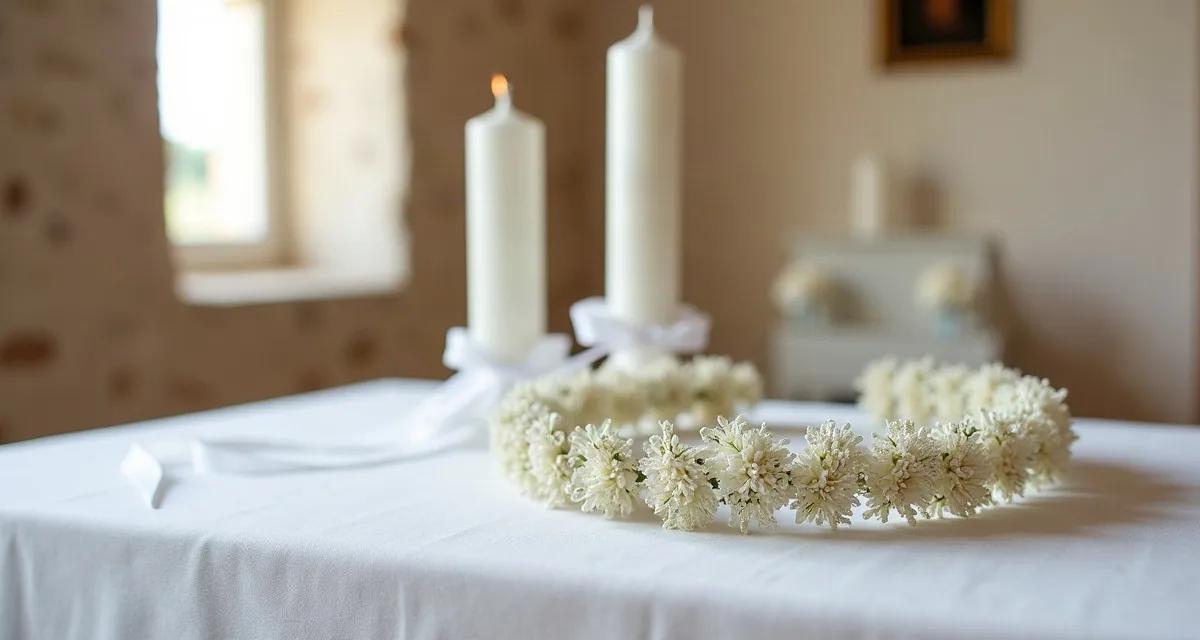
A traditional Greek wedding has two parts: an Orthodox church ceremony full of symbols, and a long celebration with family and friends. Some customs begin days before the wedding, like the making of the marital bed, and some end only when the last guest leaves with a small bundle of sugared almonds.
- The betrothal: the rings are blessed and exchanged three times.
- The crowning: two stefana joined by a single ribbon.
- The common cup and the walk around the table.
- The krevati, the koufeta and the wishes guests offer.
Two services in one ceremony
The Orthodox wedding is made of two services that follow each other: the Betrothal, with the blessing of the rings, and the Marriage Service, with the crowning. The priest blesses the rings, which are worn on the fourth finger of the right hand, and the koumbaros, the couple's sponsor, exchanges them between the couple three times. Bride and groom each hold a white candle, the lambada, for much of the service.
The stefana, the crowns of the wedding
The crowning is the heart of the ceremony and gives the service its Greek name, stepsis. The priest joins the couple's right hands, which stay joined until the end. Two crowns, the stefana, are placed on their heads and the koumbaros exchanges them three times, while the hymn asks God to crown the couple in glory and honour. The stefana are usually made of flowers or lemon blossom, sometimes of silver or gold, and are joined by a ribbon that stands for the couple's union. Many couples keep them at home after the wedding.
The common cup and the walk around the table
The couple then share a cup of wine, three sips each, in memory of the wedding at Cana. It is not Holy Communion, but a sign of the joys and sorrows they will share from now on. The priest then leads them three times around the ceremonial table, with the koumbaros following. This procession, known as the Dance of Isaiah, is a symbolic dance of joy, accompanied by hymns. At the end, the priest separates the couple's joined hands with the Gospel book.
The koumbaros and the koumbara
The koumbaros or koumbara is more than a best man or a maid of honour. They take part in the sacrament itself, exchanging the rings and the crowns, and they lead the bridal party in the walk around the table. Traditionally they buy the stefana, and they often become godparents to the couple's children. Because the role is part of the sacrament, the sponsor at an Orthodox church wedding is expected to be an Orthodox Christian.
Before the wedding: the krevati
A few days before the wedding, family and friends gather to make the couple's marital bed, the krevati. Once the bed is made, money is thrown on it to wish the couple prosperity, and in many families a baby is placed on the bed as a wish for children. It is a joyful gathering, often with music and dancing.
Koufeta, the sugared almonds
No Greek wedding ends without koufeta, sugared almonds wrapped in small bundles for every guest. They are wrapped in odd numbers, a symbol of fertility, endurance and an unbreakable bond. Koufeta or rice are also thrown over the couple as they leave the church, for sweetness and fertility in their new life.
The wishes and the celebration
Before the wedding, friends wish the couple "I ora i kali", may the time be good. After the ceremony, guests greet them with "Na zisete", which means "may you live long". The celebration that follows is about food, music and dancing, and in some regions guests pin money on the couple's clothes during the first dance.
Choosing the date
Sunday is the most traditional day for a Greek Orthodox wedding, while Tuesday is considered unlucky in Greek superstition. The Orthodox Church does not celebrate weddings during its fasting seasons and on certain feasts, including Great Lent and Holy Week and the first fifteen days of August, so a church date is always confirmed with the parish first.
Bringing Greek traditions into your wedding
Whether you marry in an Orthodox church, in a civil ceremony or in a symbolic one, many of these customs can become part of the day: koufeta for every guest, the wishes, the music and the dancing. THE CODE plans destination weddings in Greece, from venue sourcing and creative direction to guest hospitality and production. Read our guide on how to plan a wedding in Greece, see what it takes for a legal wedding in Greece, or discover our destination weddings in Greece.
Sources
- St Spyridon Parish, Marriage. https://stspyridon.org.au/sacraments/marriage
- St. Vasilios Greek Orthodox Church, Pastoral Guidelines: Weddings, Divorces, Baptisms, Funerals, and Memorials. https://www.stvasilios.org/orthodox_faith/pastoral_guidelines/pastoral_guidelines_weddings
- Neos Kosmos, A celebration of love and traditions. https://neoskosmos.com/en/2011/08/08/life/weddings/a-celebration-of-love-and-traditions/
- Greek City Times, Greek Wedding Traditions: Rituals, Symbols and Celebrations That Stand the Test of Time. https://greekcitytimes.com/2026/01/11/greek-wedding-customs-traditions-2026/
- Olympic Holidays, A Guide to Greek Wedding Traditions. https://www.olympicholidays.com/blog/a-guide-to-greek-wedding-traditions/
- Omilo, Learn Greek wishes, for celebrations and social occasions. https://omilo.com/wish-greek-celebrations-events/